Follow Me On Social Media!


The Best Homemade Croissant Recipe: Flaky, Buttery Bliss

Introduction to The Best Homemade Croissant Recipe
Imagine waking up to the warm, buttery aroma of freshly baked croissants wafting through your kitchen. It’s a scent that promises comfort and indulgence, inviting you to take that first delightful bite. In this blog post, we’re excited to guide you through the best homemade croissant recipe, a culinary adventure that transforms simple ingredients into a delicate pastry that’s crispy on the outside and wonderfully flaky on the inside.
Homemade croissants hold a special place in the world of baking. They’re not just a treat; they’re a labor of love that speaks volumes about the joy of cooking. Each layer of dough represents a step in the craft of baking—a process full of patience, technique, and a sprinkle of magic. But what truly sets the best homemade croissant recipe apart from store-bought options? It’s all about using fresh ingredients and appreciating the artistry involved.
What Makes Homemade Croissants Irresistible?
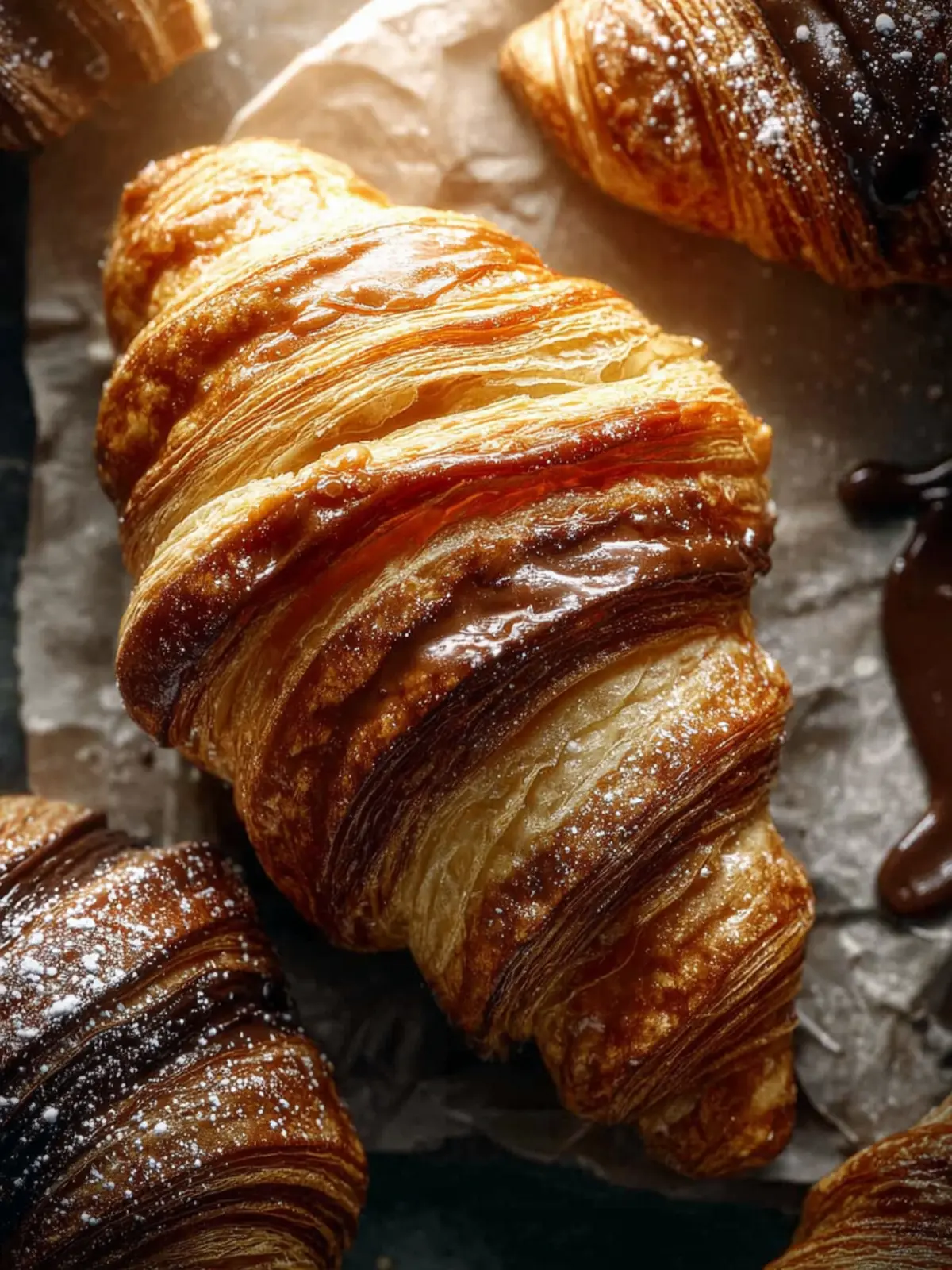
When it comes to croissants, freshness is key. Picture the moment you crack open a perfectly baked croissant, revealing its glorious layers. The contrast between the light, airy interior and the crisp outer shell is simply mouthwatering. Here’s why homemade croissants are truly irresistible:
- Flaky Layers: The lamination process, where cold butter is folded into the dough, creates those coveted layers. Each fold is essential for crafting the ultimate flaky texture.
- Quality Ingredients: Using high-quality butter and flour makes a world of difference. The richness from the butter offers depth of flavor that you can’t replicate with mass-produced options.
- Personal Touch: Baking at home allows you to experiment with flavors and fillings, whether it’s classic almond or adventurous chocolate.
- Freshness Counts: The ability to enjoy them straight from the oven is unbeatable. Homemade croissants are delightful when still warm, adding a touch of magic to your breakfast or brunch table.
Embrace the journey of making the best homemade croissant recipe, and soon, you’ll find that the experience is just as delightful as the end result. Are you ready to elevate your baking game and impress your friends and family with your croissant-making prowess? Let’s dive in!

Key Ingredients for The Best Homemade Croissant Recipe
Creating the best homemade croissant recipe starts with selecting the perfect ingredients, each one playing a vital role in the flaky allure of these pastries.
-
Flour: All-purpose flour is my go-to, but bread flour can provide even more structure for those perfectly layered croissants. The higher protein content helps develop gluten, which is critical for that desirable chew.
-
Butter: Quality butter is essential; I recommend using unsalted European-style butter for its higher fat content. It melts beautifully into the dough, giving the croissants a rich flavor and those iconic layers.
-
Yeast: Fresh active dry yeast is the secret behind that lovely rise. It gives the croissants their airy texture, creating those delightful bubbles that define a great croissant.
-
Milk: Whole milk contributes to tenderness and richness in the dough. If you’re feeling adventurous, try using a splash of cream for extra decadence.
-
Sugar and Salt: A pinch of sugar not only helps with the yeast activation but also enhances flavor. Salt is a must; it balances the sweetness and boosts the overall taste of the pastry.
Gather these ingredients, and you’re well on your way to crafting the best homemade croissant recipe that will impress everyone at your brunch table.
Why You’ll Love This Homemade Croissant Recipe
There’s something utterly magical about making the best homemade croissant recipe right in your own kitchen. Picture a sunny morning, the scent of buttery pastry wafting through your home, and a freshly baked croissant golden brown, with flaky layers ready to be torn apart. It’s more than just a treat; it’s an experience that brings the joy of a French café straight to your breakfast table.
Crafting croissants from scratch may seem intimidating, but with this recipe, you’ll find that the process is inventive and rewarding. The satisfaction of rolling out that delicate dough, layering it with rich butter, and watching it puff up beautifully in the oven will elevate your baking game to new heights.
Here’s why this recipe will steal your heart:
- Fresh Ingredients: You’ll be using high-quality flour and real butter, making a world of difference in flavor and texture.
- Impressive Results: The buttery, flaky layers will make you the star baker among friends and family.
- Satisfying Process: The folding and rolling techniques can be therapeutic, transforming your kitchen into a creative space.
- Customization: Experiment with fillings, from chocolate to almond cream, to find your perfect croissant combination.
With every bite, you’ll appreciate the flavor and effort that went into making these beautiful pastries at home. Get ready to impress yourself!
Tips for Making Perfect Homemade Croissants
If you’ve ever dreamed of crafting the best homemade croissant recipe in your own kitchen, you’re in for a delicious journey. Perfecting croissants is a delightful challenge, and here’s how you can glide through it with ease.
Choose the Right Butter
Using high-quality European-style butter is non-negotiable for the best croissants. Its higher fat content makes for flakier layers, which means that luxurious, melt-in-your-mouth experience. Make sure it’s cold but pliable for optimal lamination.
Keep Everything Cold
Temperature is your friend. Ensure that your dough, as well as your work surface, remains cool throughout the process. This prevents the butter from melting into the dough, allowing for those exquisite, airy layers we all crave in a croissant.
Don’t Rush the Lamination Process
Take your time when rolling and folding. Each turn is crucial for building those beloved layers. Aim for a texture that feels similar to a thick book — it should be even and smooth. Rushing might compromise the final result.
Let It Rise
Patience pays off! After shaping the croissants, give them plenty of time to proof. If you let them rise until they double in size, you’ll end up with beautifully airy pastries that are sure to impress.
Bake for Perfection
Preheat your oven to the right temperature before baking. A hotter oven can give you that lovely golden color and crisp texture. Keep an eye on them; every oven is a little different, and a few minutes can make a big difference!
By following these essential tips, you’ll be well on your way to creating the best homemade croissant recipe that friends and family will rave about. Happy baking!
Time Details for The Best Homemade Croissant Recipe
Crafting the best homemade croissant recipe is not just about the ingredients but also the patience it requires. Each step in this journey enhances the flavor and texture, making it all worth it. Here’s a quick snapshot of the time commitment involved:
-
Preparation time: 30 minutes
This includes measuring ingredients and mixing the dough. -
Chilling time: 4 hours
Allow the dough to rest in the fridge to develop flavor and texture. -
Rising time: 2 hours
Letting the croissants rise is crucial for that fluffy, airy bite. -
Baking time: 20-25 minutes
The magic happens in the oven as they puff and turn golden brown. -
Total time: ~6 hours
This might seem like a long day, but trust me, it’s all about savoring the process!

Nutritional Information for The Best Homemade Croissant Recipe
When you indulge in the best homemade croissant recipe, you’re not just enjoying layers of flaky goodness. You’re also tapping into a delicious balance of nutrition. Here’s a closer look at what’s packed into these buttery delights.
Calories
Each croissant packs around 250 calories, making it a delightful treat when enjoyed in moderation. These are calorie-dense, so pair them with fresh fruit or a warm beverage for a well-rounded snack.
Protein
With approximately 5 grams of protein per serving, croissants provide a light boost to your daily intake. While not the highest source, every bit helps, especially when paired with protein-rich spreads like almond butter or a classic whipped cream cheese.
Sodium
The sodium content hovers around 250 milligrams. This is reasonable, considering the rich flavor you’re savoring. Keep this in mind if you’re watching your sodium intake, but don’t shy away from enjoying this irresistible pastry!
Remember, the balance you create around enjoying these delicate pastries can make your culinary experience both delightful and nutritious!
FAQs about The Best Homemade Croissant Recipe
Baking the best homemade croissant recipe turns your kitchen into a haven of buttery goodness, but questions can pop up along the way. Let’s address some common concerns!
How can I make my croissants even flakier?
If you want to achieve that coveted flaky texture in your croissant, it’s all about the layers! Ensure your dough is well-chilled before each fold, as this helps maintain the butter’s structure. Additionally, using high-quality butter with a higher fat content can make a noticeable difference. Lastly, avoid overworking your dough; gentle handling preserves the air pockets, leading to a lighter croissant.
What should I do if my dough doesn’t rise?
Don’t fret if your dough seems stubborn! Ensure your yeast is fresh and active—the best way to test is to see if it foams when mixed with warm water and a bit of sugar. If the dough still fails to rise, consider giving it a longer resting period in a warmer environment. Sometimes, a little patience goes a long way in achieving beautifully risen croissants.
Can I freeze uncooked croissants?
Absolutely! Freezing uncooked croissants is a fantastic way to save time later. Simply shape them, place them on a baking sheet to chill, and once firm, transfer them to a freezer bag. They can be baked straight from the freezer; just add a few extra minutes to the baking time.
How do I store leftover croissants?
To keep your croissants fresh, store them in an airtight container at room temperature for up to two days. For longer storage, wrap them tightly in foil or plastic wrap and freeze. When you’re ready to enjoy, a quick pop in the oven can bring back their lovely texture!
Conclusion on The Best Homemade Croissant Recipe
In summary, the journey to creating the best homemade croissant recipe is a rewarding one that combines patience, technique, and quality ingredients. Once you master the art of laminating dough, you’ll unlock the secrets of flaky, buttery layers that are hard to resist. Remember, the key is to enjoy the process and savor the moments of kneading, rolling, and folding. Whether you share these croissants with friends or keep them all to yourself, the satisfaction from making them from scratch is unparalleled. Embrace your culinary skills, and get ready to impress everyone with this delightful masterpiece!
Print
Croissant
- Total Time: 10 hours
- Yield: 16 croissants 1x
- Diet: Vegetarian
Description
A flaky and buttery classic French pastry made from a rich, layered dough.
Ingredients
Scale
- 4 cups all-purpose flour (T45)
- 1/4 cup + 1 tbsp sugar
- 3 1/4 tsp active dry yeast
- 6 1/2 tbsp milk, cold
- 7 tbsp unsalted butter, at room temperature
- 2 tsp salt
- 1/2 cup + 1 tsp cold water
- 1 cup + 2 tbsp unsalted butter, cold
- 1 egg
- 1 egg yolk
Instructions
- In a large mixing bowl, with a stand or handheld mixer fitted with a dough hook stir together flour, sugar, yeast, milk, soft butter, and salt. Stir on low speed until it starts to come together. Slowly add water while mixing the dough. Knead on medium-low speed for 10 minutes. Shape the dough into a 9 inches (25x17cm) rectangle. Wrap tightly with plastic foil and refrigerate overnight (8-12 hours).
- Place the cold butter between 2 pieces of parchment or wax paper. With a rolling pin, pound butter into a 7 inches (18x18cm) rectangle. Straighten the sides with the outer edges of your hands by pushing towards the center. Roll evenly thick. Cover with plastic wrap and freeze butter and the croissant dough for 20 minutes.
- Remove dough from the freezer and roll on a very lightly floured surface with a very lightly floured rolling pin into a 15×7 inches (38×20 cm) rectangle, 0 inches (7-8mm) thick. Place butter slab on one half of the croissant dough so that there is about 0 inches space around three edges and fold the other dough-half over the butter. Completely seal the butter inside the dough by pressing the edges together. Make sure that there are no air bubbles between the layers. Rotate 90°.
- Just use as much flour as needed that the dough doesn’t stick. Firmly but carefully press the dough with the rolling pin starting on both sealed ends. Then stop pressing and begin rolling the dough. Be careful and don’t work the dough over that the butter doesn’t incorporate with the dough. Roll the croissant dough just in one direction into a 15×7 inches (38×20 cm) rectangle, 0 inches (7-8mm) thick. Rotate the dough 180° while rolling to keep it even, if needed. Make sure that you lengthen the dough instead of widening it and keep the edges as straight as possible. Shape the corners with your hands to a square.
- Remove all excess flour from the dough before folding it, if there is any. Take one short side and fold one-third of the dough over itself that about 2/3 of the dough is covered by itself. Then take the other short side and flap it over itself that it touches the edge of the previously folded part. The croissant dough has now 1/3 of its original size. Then fold it in half. You should have a rectangle with 4 layers of dough. Be sure that you remove all excess flour between each layer. Cover with plastic foil tightly and freeze for 30 minutes.
- Roll the dough in the direction of the two open ends with the fold to your right until it is a 15×7 inches (38×20 cm) rectangle, 0 inches (7-8mm) thick. Be careful, not to overwork the dough and take as little flour as possible. Keep the edges as straight as possible. Rotate 180° while rolling to stay even, if needed. Pick up one short end and fold one-third of the dough on itself. Pick up the other short end and fold on top that it covers itself (letter style). You should have a 3-layered dough. Cover with plastic foil tightly and freeze for 30 minutes.
- Turn the dough again by 90° from the previous position, and roll into a 26×10 inches (66x27cm) rectangle, 0 inches (3-4mm) thick. And again, take as little flour as possible, keep the edges as straight as possible, and don’t overwork the dough. Shape the corners with your hands to a square.
- With a sharp knife or pizza cutter, cut off 0 inches all around the rectangle to reveal the multilayered puff pastry. The croissant dough should be 25 inches (64x25cm) in size. Transform it into a parallelogram by picking up 2 corners of the dough opposite the diagonal and stretch gently. Use a tape measure or yardstick and measure both long sides of the dough (should be still 25 inches / 64cm) and divide each side through 7-8. This makes sure that your croissants are all the same size. Depending on your parallelogram and the precision of your cut, you get 14 or 16 croissants. Then cut triangles with the tape measure. The cut croissants should be between 3 inches (8-9cm) wide and 9 inches (25cm) long. Cover with plastic foil and freeze for 15 minutes.
- Line 3 baking sheets with parchment paper. Set aside.
- Remove croissants from the freezer and cut with a knife 0 (5mm) slits in the middle of the short sides. Place croissants with the notched side towards you. Roll the dough up and away from you, moving your hands outward from the center. Lightly press the tip to close the croissants. Place croissants on prepared baking sheets (a maximum of 6 croissants per baking sheet) with enough space between each croissant. They will triple in size. Place the dough tip underneath that they don’t unroll during baking.
- Combine egg and egg yolk in a small bowl and lightly brush croissants. Your oven should have a temperature of 80-85°F (26-29°C). Maybe you need to open the door for 1-2 minutes if it is warmer than that.
- Pour boiling water in a heat-proof bowl. Arrange all baking sheets in the oven and the boiling water on the bottom of the oven. Close the door and let the croissants rise for 2 hours. This trick can simulate a professional oven. It lets the croissants rise high and prevents them from drying out.
- Remove croissants from the oven and preheat to 375°F (190°C). Carefully brush croissants a second time with eggs. Bake one sheet at the time for about 16-20 minutes until they have a brown and even color. Let cool on the baking sheets for 5 minutes then transfer to a wire rack to cool completely. Even if the croissants are best eaten fresh on the same day, you can store them in an airtight container at room temperature up to 3 days. Dip or drizzle with chocolate, dust with powdered sugar, or fill to your taste, if desired.
Notes
- Store croissants in an airtight container at room temperature for up to 3 days.
- Best when served fresh the same day they are baked.
- For added flavor, you can dip or drizzle with chocolate or dust with powdered sugar.
- Prep Time: 1 hour 30 minutes
- Cook Time: 20 minutes
- Category: Pastries
- Method: Baking
- Cuisine: French
Nutrition
- Serving Size: 1 croissant
- Calories: 200
- Sugar: 2g
- Sodium: 150mg
- Fat: 12g
- Saturated Fat: 7g
- Unsaturated Fat: 4g
- Trans Fat: 0g
- Carbohydrates: 22g
- Fiber: 1g
- Protein: 4g
- Cholesterol: 30mg